ResourcesCheat Sheet Pro
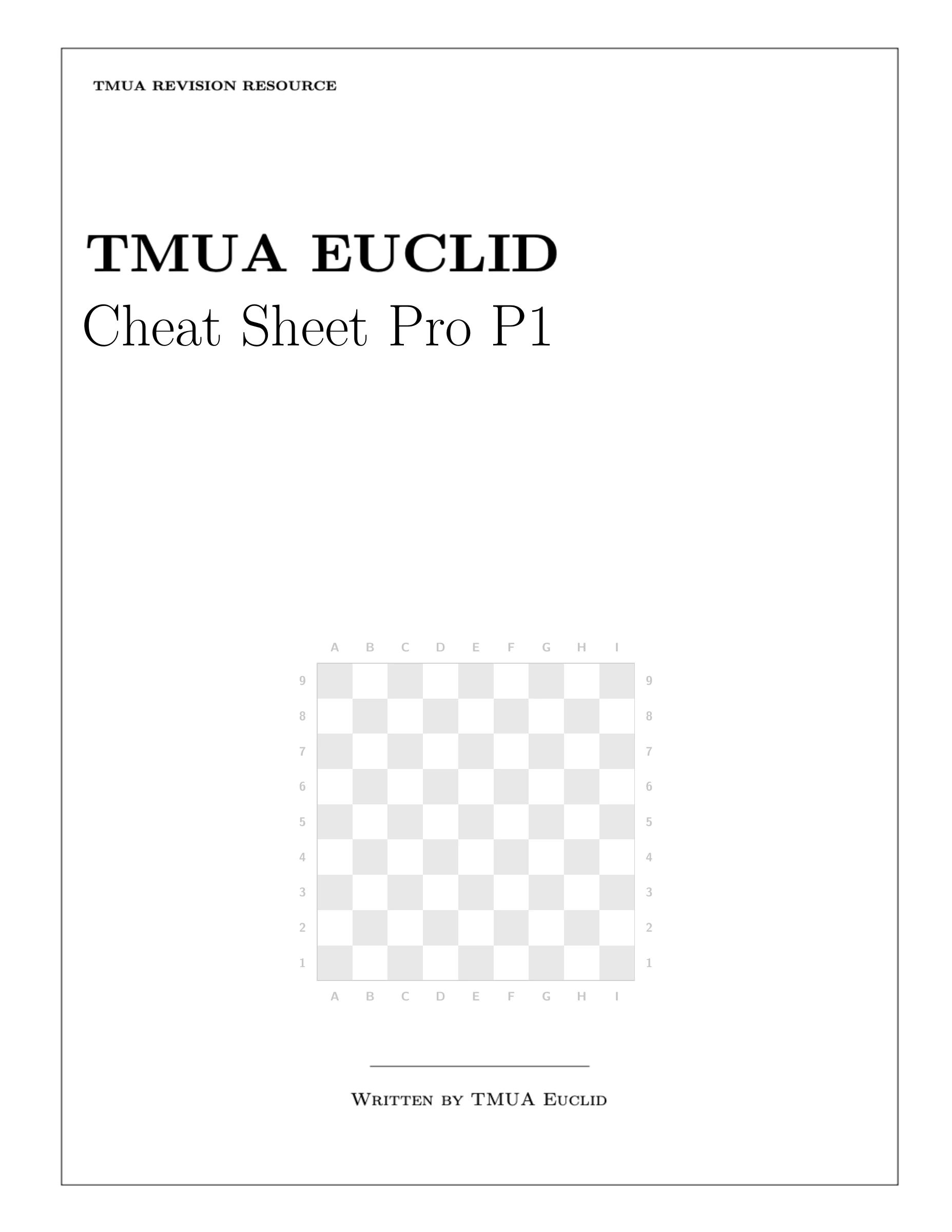
The front cover of TMUA Euclid Cheat Sheet Pro

TMUA · EUCLID / PAPER 1

Cheat Sheet Pro

What’s included

  • Written by mathematicians
  • Everything you need to know for TMUA Paper 1.
  • 420-page PDF with 14 chapters and 98 methods.
  • Concept explanations, key conditions and common mistakes.
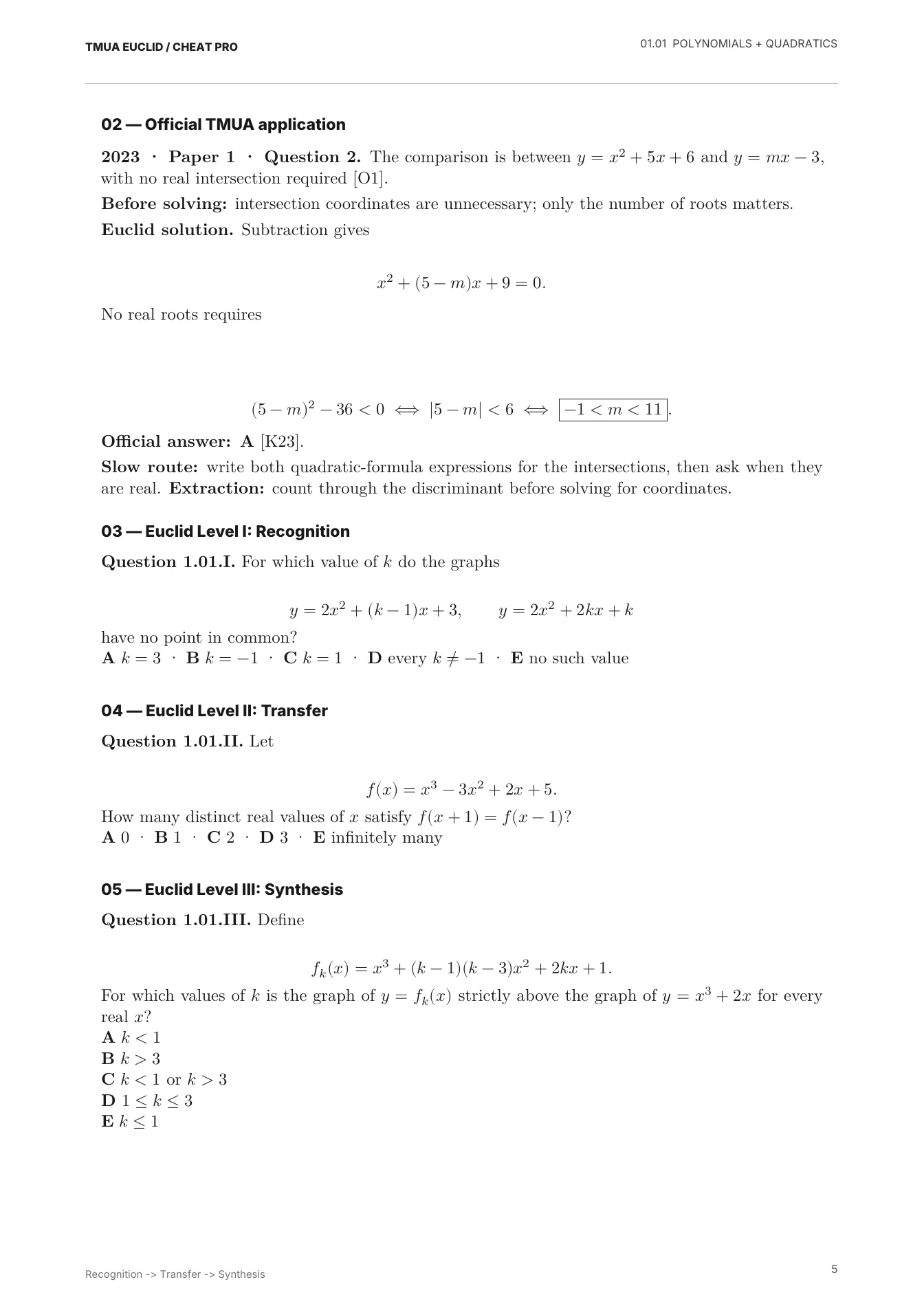
  • Worked applications using official TMUA questions.
  • 294 original Euclid questions with detailed worked solutions.
  • Takes around 8 hours to complete.
£79

ONE-TIME PURCHASE · DIGITAL PDF

More info Take a look inside the resource

02 / THE TOPICS

Fourteen chapters. Ninety-eight methods.
Explore the contents, then step inside 5.01.

Chapters 01–07
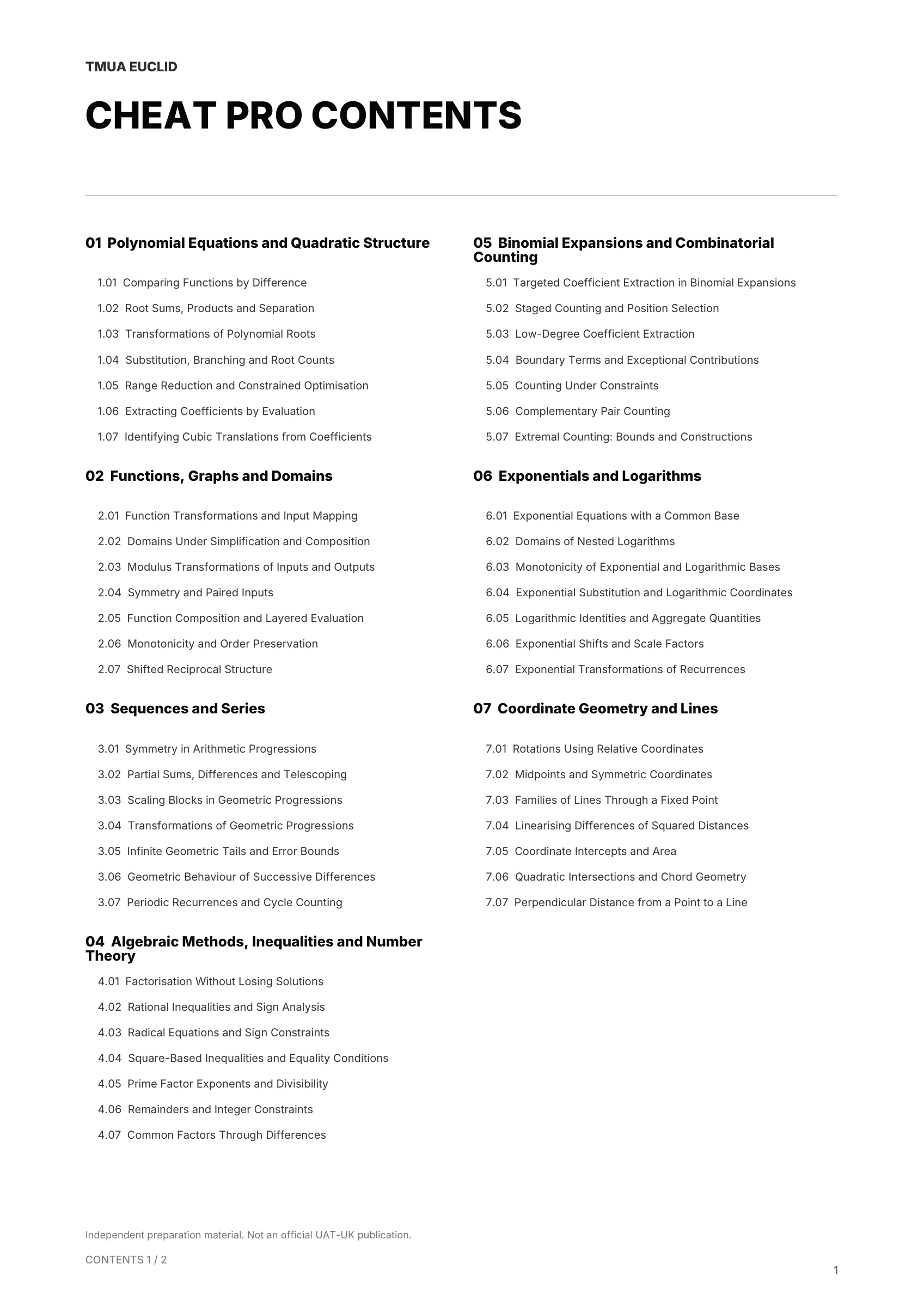
Cheat Sheet Pro master contents, chapters 01 to 07. Section 5.01 is highlighted as the free example.

Polynomial Equations and Quadratic Structure

  1. 1.01 Comparing Functions by Difference
  2. 1.02 Root Sums, Products and Separation
  3. 1.03 Transformations of Polynomial Roots
  4. 1.04 Substitution, Branching and Root Counts
  5. 1.05 Range Reduction and Constrained Optimisation
  6. 1.06 Extracting Coefficients by Evaluation
  7. 1.07 Identifying Cubic Translations from Coefficients

Functions, Graphs and Domains

  1. 2.01 Function Transformations and Input Mapping
  2. 2.02 Domains Under Simplification and Composition
  3. 2.03 Modulus Transformations of Inputs and Outputs
  4. 2.04 Symmetry and Paired Inputs
  5. 2.05 Function Composition and Layered Evaluation
  6. 2.06 Monotonicity and Order Preservation
  7. 2.07 Shifted Reciprocal Structure

Sequences and Series

  1. 3.01 Symmetry in Arithmetic Progressions
  2. 3.02 Partial Sums, Differences and Telescoping
  3. 3.03 Scaling Blocks in Geometric Progressions
  4. 3.04 Transformations of Geometric Progressions
  5. 3.05 Infinite Geometric Tails and Error Bounds
  6. 3.06 Geometric Behaviour of Successive Differences
  7. 3.07 Periodic Recurrences and Cycle Counting

Algebraic Methods, Inequalities and Number Theory

  1. 4.01 Factorisation Without Losing Solutions
  2. 4.02 Rational Inequalities and Sign Analysis
  3. 4.03 Radical Equations and Sign Constraints
  4. 4.04 Square-Based Inequalities and Equality Conditions
  5. 4.05 Prime Factor Exponents and Divisibility
  6. 4.06 Remainders and Integer Constraints
  7. 4.07 Common Factors Through Differences

Binomial Expansions and Combinatorial Counting

  1. 5.01 Targeted Coefficient Extraction in Binomial Expansions
  2. 5.02 Staged Counting and Position Selection
  3. 5.03 Low-Degree Coefficient Extraction
  4. 5.04 Boundary Terms and Exceptional Contributions
  5. 5.05 Counting Under Constraints
  6. 5.06 Complementary Pair Counting
  7. 5.07 Extremal Counting: Bounds and Constructions

Exponentials and Logarithms

  1. 6.01 Exponential Equations with a Common Base
  2. 6.02 Domains of Nested Logarithms
  3. 6.03 Monotonicity of Exponential and Logarithmic Bases
  4. 6.04 Exponential Substitution and Logarithmic Coordinates
  5. 6.05 Logarithmic Identities and Aggregate Quantities
  6. 6.06 Exponential Shifts and Scale Factors
  7. 6.07 Exponential Transformations of Recurrences

Coordinate Geometry and Lines

  1. 7.01 Rotations Using Relative Coordinates
  2. 7.02 Midpoints and Symmetric Coordinates
  3. 7.03 Families of Lines Through a Fixed Point
  4. 7.04 Linearising Differences of Squared Distances
  5. 7.05 Coordinate Intercepts and Area
  6. 7.06 Quadratic Intersections and Chord Geometry
  7. 7.07 Perpendicular Distance from a Point to a Line
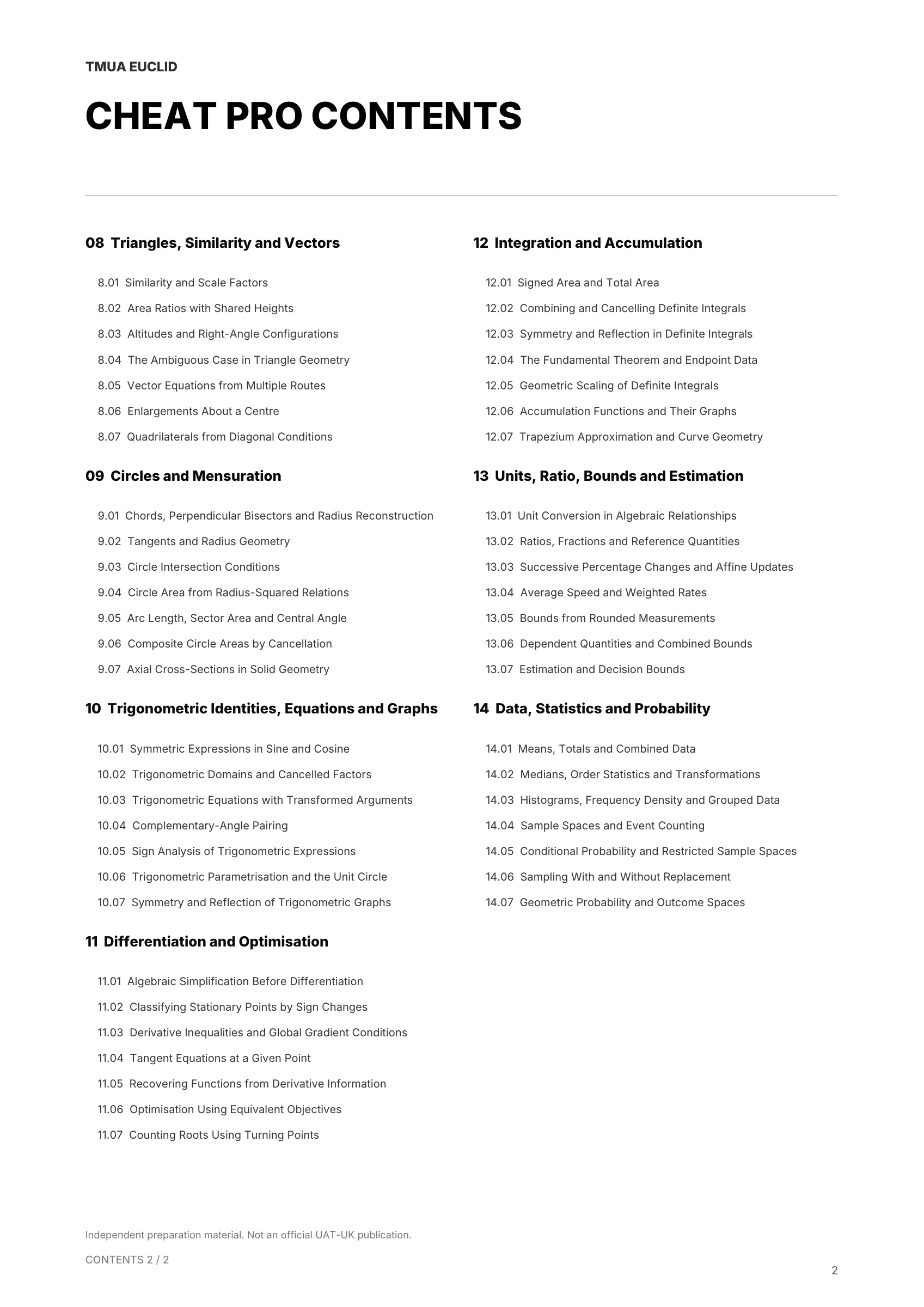
Cheat Sheet Pro master contents, chapters 08 to 14

Triangles, Similarity and Vectors

  1. 8.01 Similarity and Scale Factors
  2. 8.02 Area Ratios with Shared Heights
  3. 8.03 Altitudes and Right-Angle Configurations
  4. 8.04 The Ambiguous Case in Triangle Geometry
  5. 8.05 Vector Equations from Multiple Routes
  6. 8.06 Enlargements About a Centre
  7. 8.07 Quadrilaterals from Diagonal Conditions

Circles and Mensuration

  1. 9.01 Chords, Perpendicular Bisectors and Radius Reconstruction
  2. 9.02 Tangents and Radius Geometry
  3. 9.03 Circle Intersection Conditions
  4. 9.04 Circle Area from Radius-Squared Relations
  5. 9.05 Arc Length, Sector Area and Central Angle
  6. 9.06 Composite Circle Areas by Cancellation
  7. 9.07 Axial Cross-Sections in Solid Geometry

Trigonometric Identities, Equations and Graphs

  1. 10.01 Symmetric Expressions in Sine and Cosine
  2. 10.02 Trigonometric Domains and Cancelled Factors
  3. 10.03 Trigonometric Equations with Transformed Arguments
  4. 10.04 Complementary-Angle Pairing
  5. 10.05 Sign Analysis of Trigonometric Expressions
  6. 10.06 Trigonometric Parametrisation and the Unit Circle
  7. 10.07 Symmetry and Reflection of Trigonometric Graphs

Differentiation and Optimisation

  1. 11.01 Algebraic Simplification Before Differentiation
  2. 11.02 Classifying Stationary Points by Sign Changes
  3. 11.03 Derivative Inequalities and Global Gradient Conditions
  4. 11.04 Tangent Equations at a Given Point
  5. 11.05 Recovering Functions from Derivative Information
  6. 11.06 Optimisation Using Equivalent Objectives
  7. 11.07 Counting Roots Using Turning Points

Integration and Accumulation

  1. 12.01 Signed Area and Total Area
  2. 12.02 Combining and Cancelling Definite Integrals
  3. 12.03 Symmetry and Reflection in Definite Integrals
  4. 12.04 The Fundamental Theorem and Endpoint Data
  5. 12.05 Geometric Scaling of Definite Integrals
  6. 12.06 Accumulation Functions and Their Graphs
  7. 12.07 Trapezium Approximation and Curve Geometry

Units, Ratio, Bounds and Estimation

  1. 13.01 Unit Conversion in Algebraic Relationships
  2. 13.02 Ratios, Fractions and Reference Quantities
  3. 13.03 Successive Percentage Changes and Affine Updates
  4. 13.04 Average Speed and Weighted Rates
  5. 13.05 Bounds from Rounded Measurements
  6. 13.06 Dependent Quantities and Combined Bounds
  7. 13.07 Estimation and Decision Bounds

Data, Statistics and Probability

  1. 14.01 Means, Totals and Combined Data
  2. 14.02 Medians, Order Statistics and Transformations
  3. 14.03 Histograms, Frequency Density and Grouped Data
  4. 14.04 Sample Spaces and Event Counting
  5. 14.05 Conditional Probability and Restricted Sample Spaces
  6. 14.06 Sampling With and Without Replacement
  7. 14.07 Geometric Probability and Outcome Spaces
5.01 A complete example

03 / ONE COMPLETE EXAMPLE

5.01 Targeted Coefficient Extraction in Binomial Expansions

This is one method from Cheat Sheet Pro. Scroll through the idea, the exam application and the practice that makes it stick.

01 / THE CONCEPTEXAMPLE 5.01
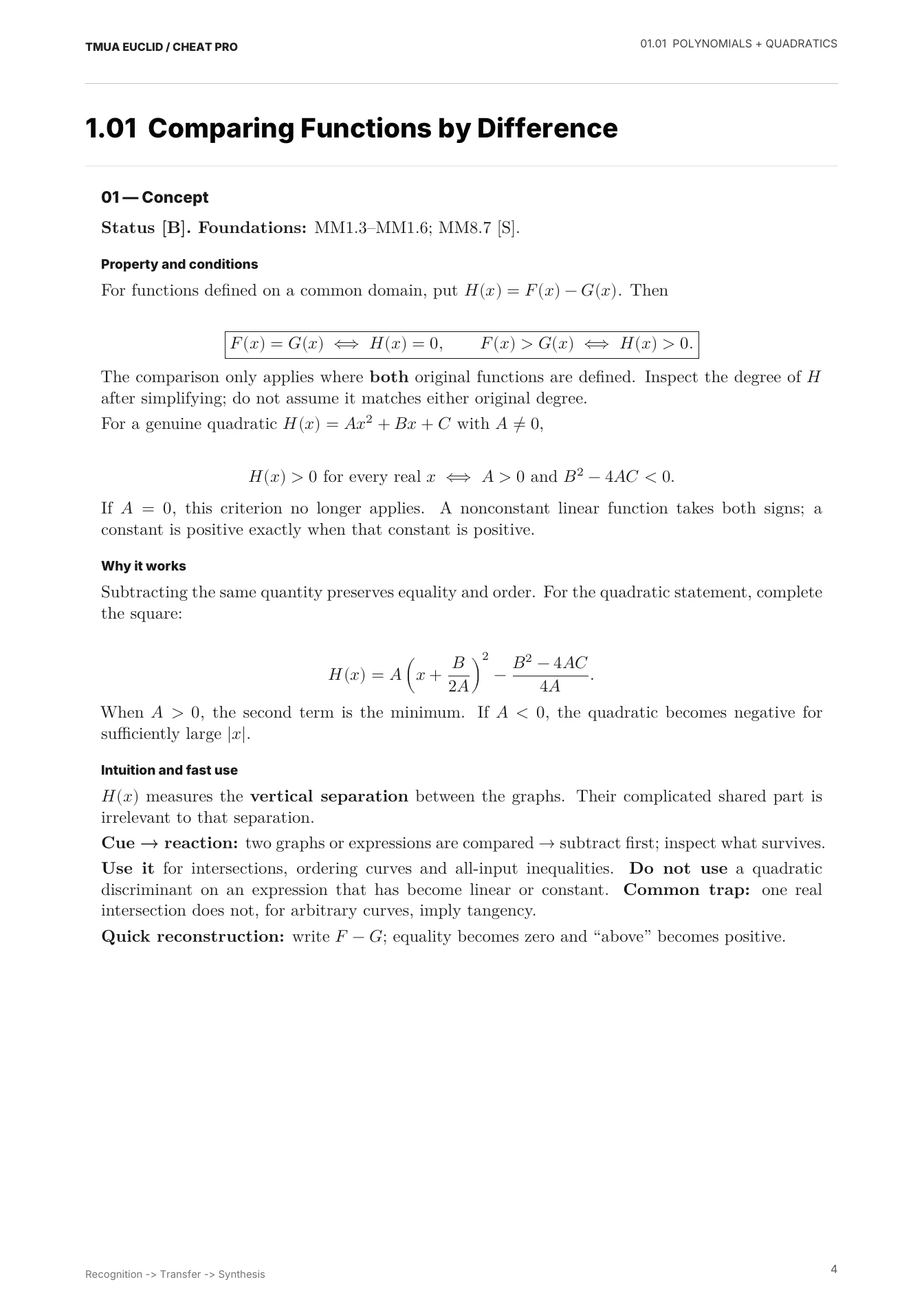
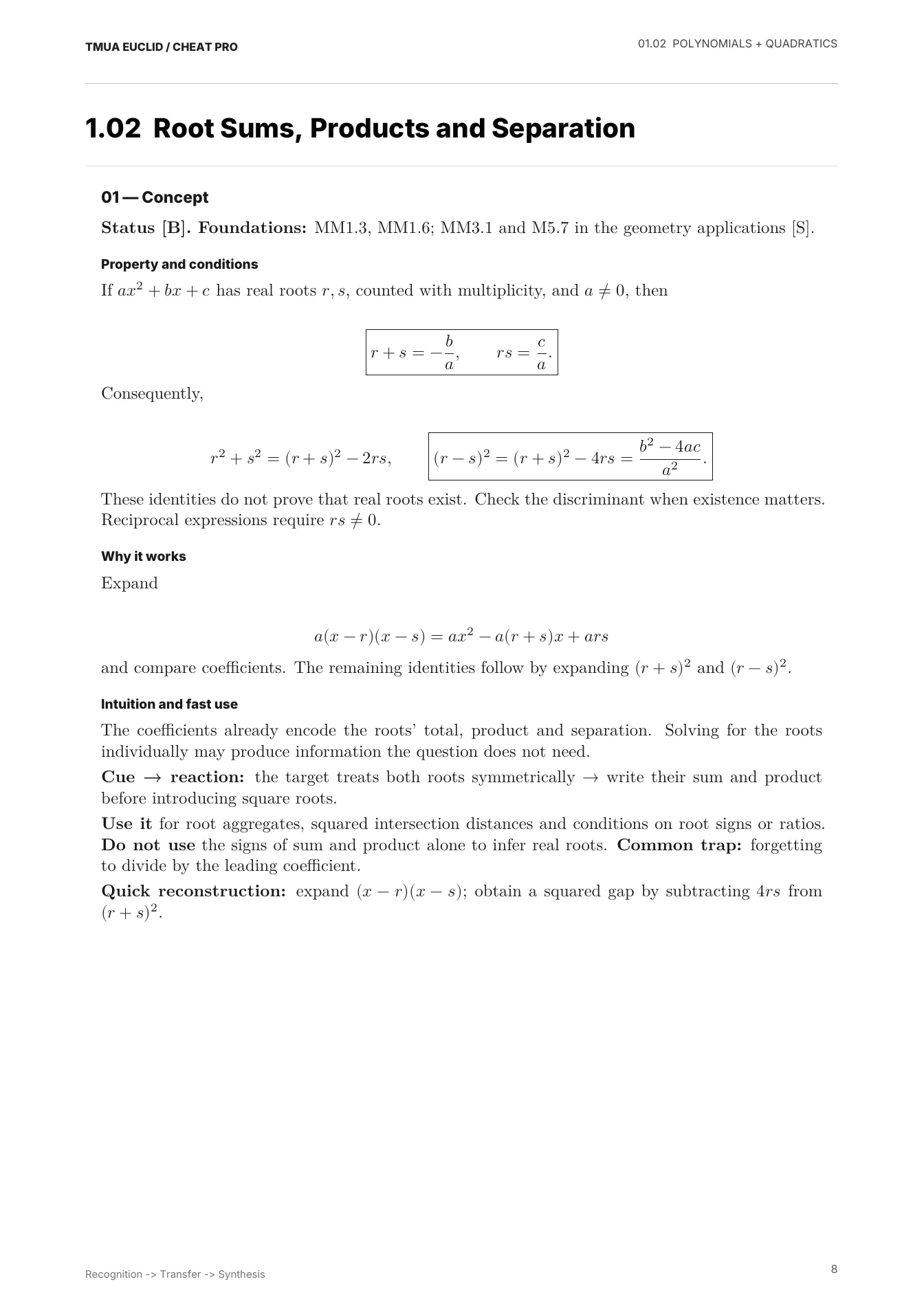
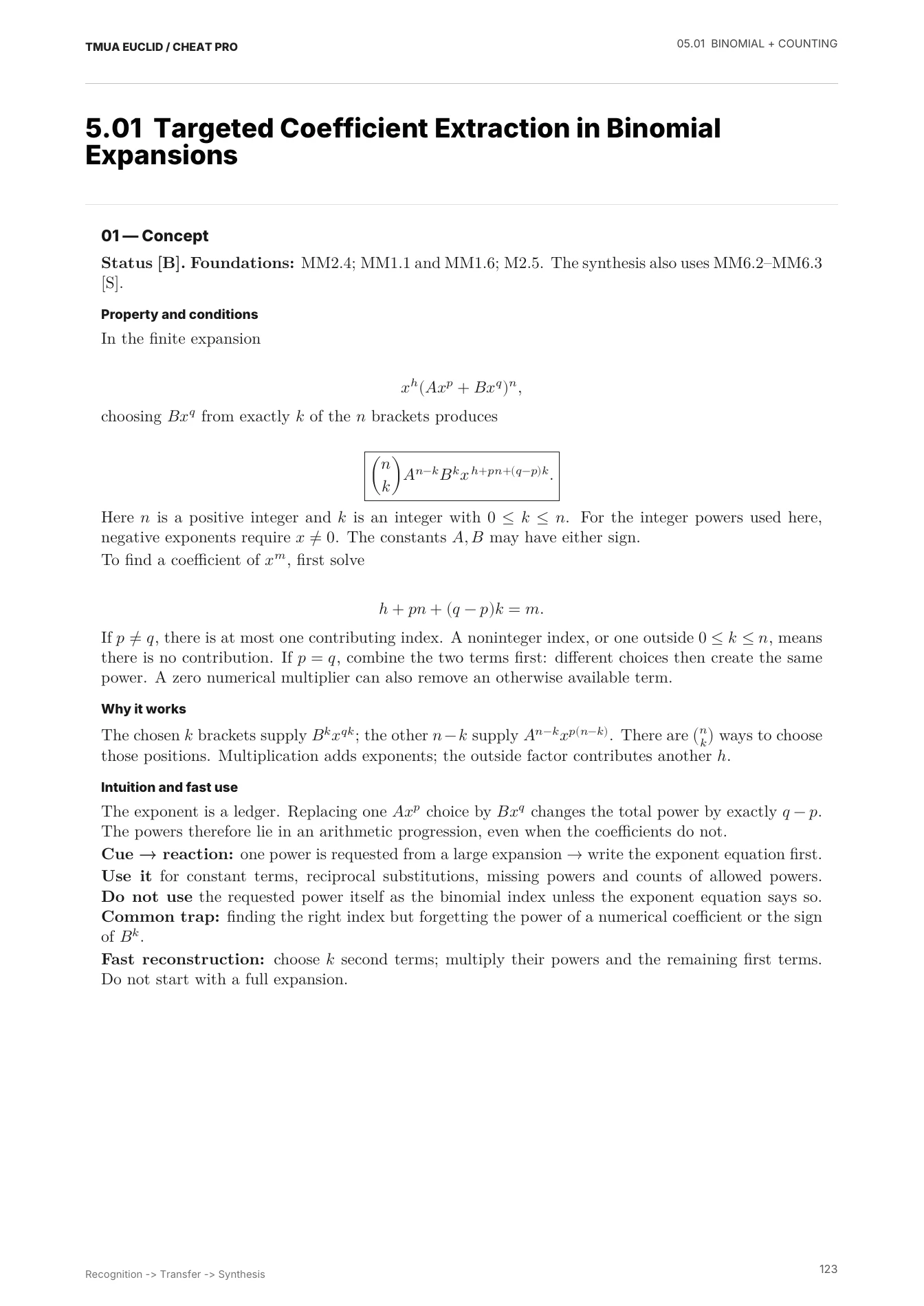
The concept page from example 5.01

01 / THE CONCEPT

Understand why the method works.

Start with the principle, its conditions and the cue that tells you to use it. The page explains the reasoning, the common trap and a quick way to reconstruct the result.

IN THIS EXAMPLE

Only one coefficient is needed. Match the power of x first, then calculate the term that produces it.

h + pn + (q − p)k = m
Section 5.01 · TMUA application and Euclid questions

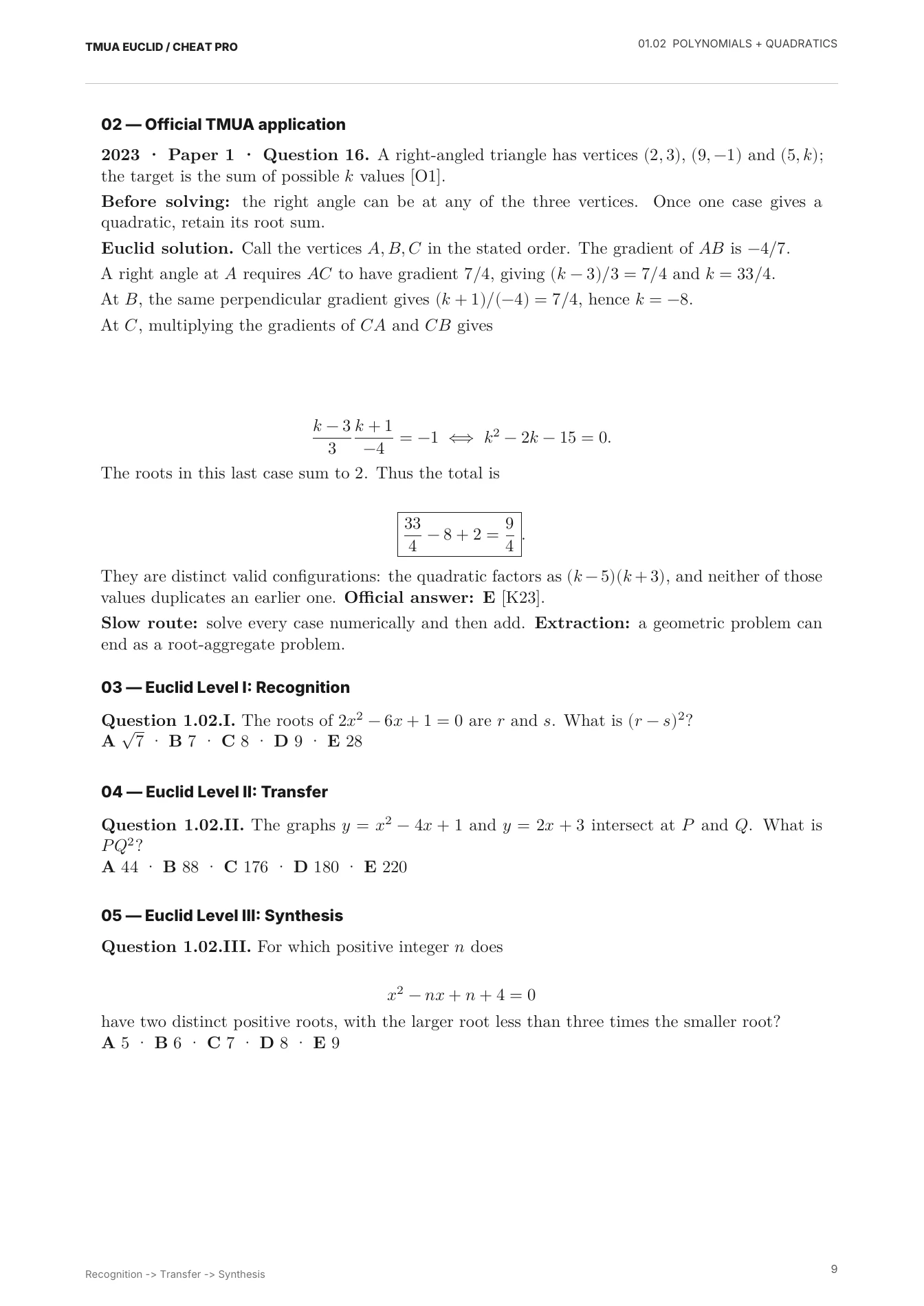
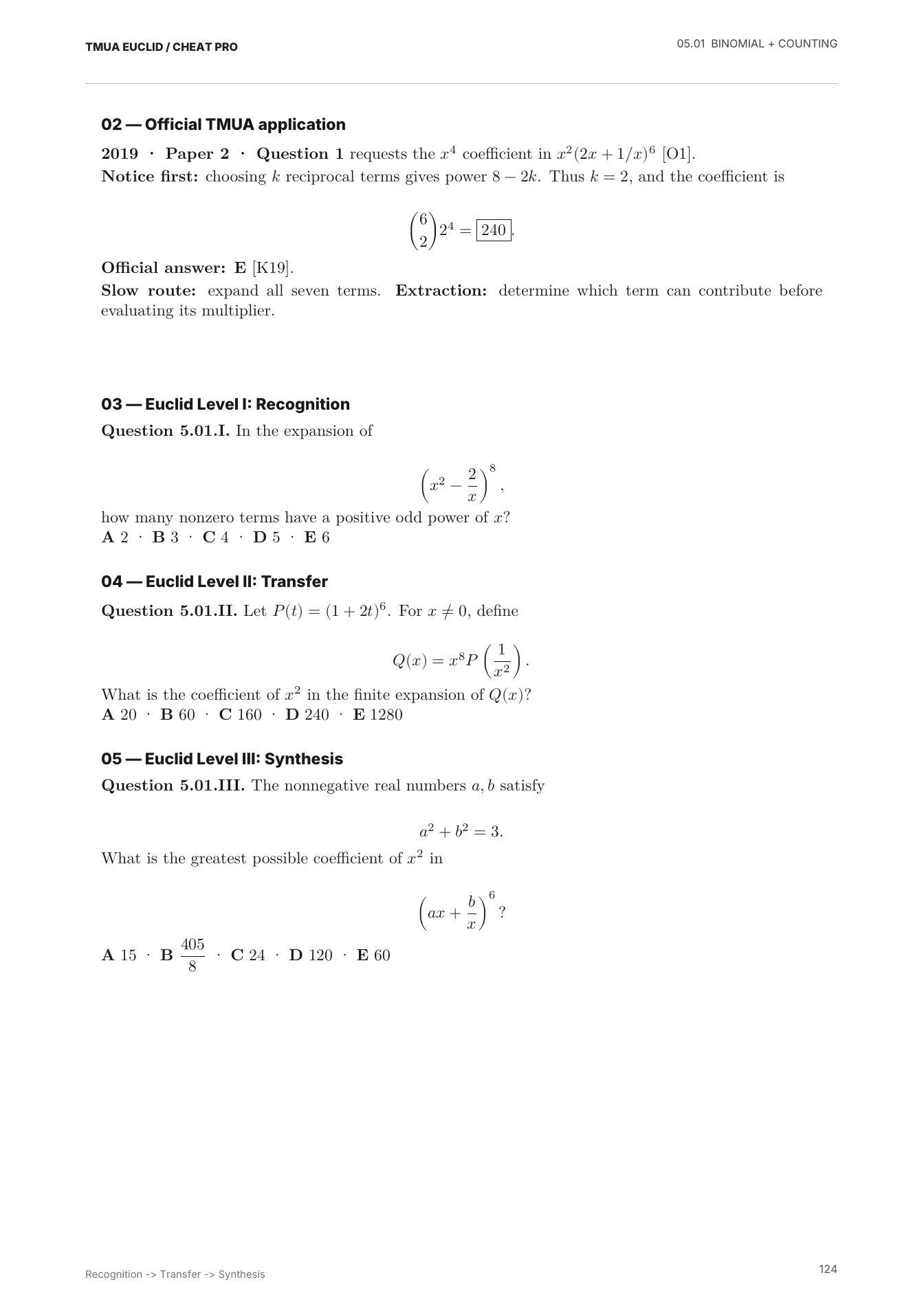
02 / OFFICIAL TMUA APPLICATION

See the idea earn its place.

A real past-paper question shows where the method is useful. The explanation identifies what to notice first, contrasts the longer route and works through the decisive step.

2019 · PAPER 2 · QUESTION 1

Find the coefficient of x4 in x2(2x + 1/x)6.

8 − 2k = 4
k = 2
240

One contributing term. No full expansion.

The source is an official TMUA question; the explanation is Euclid’s.

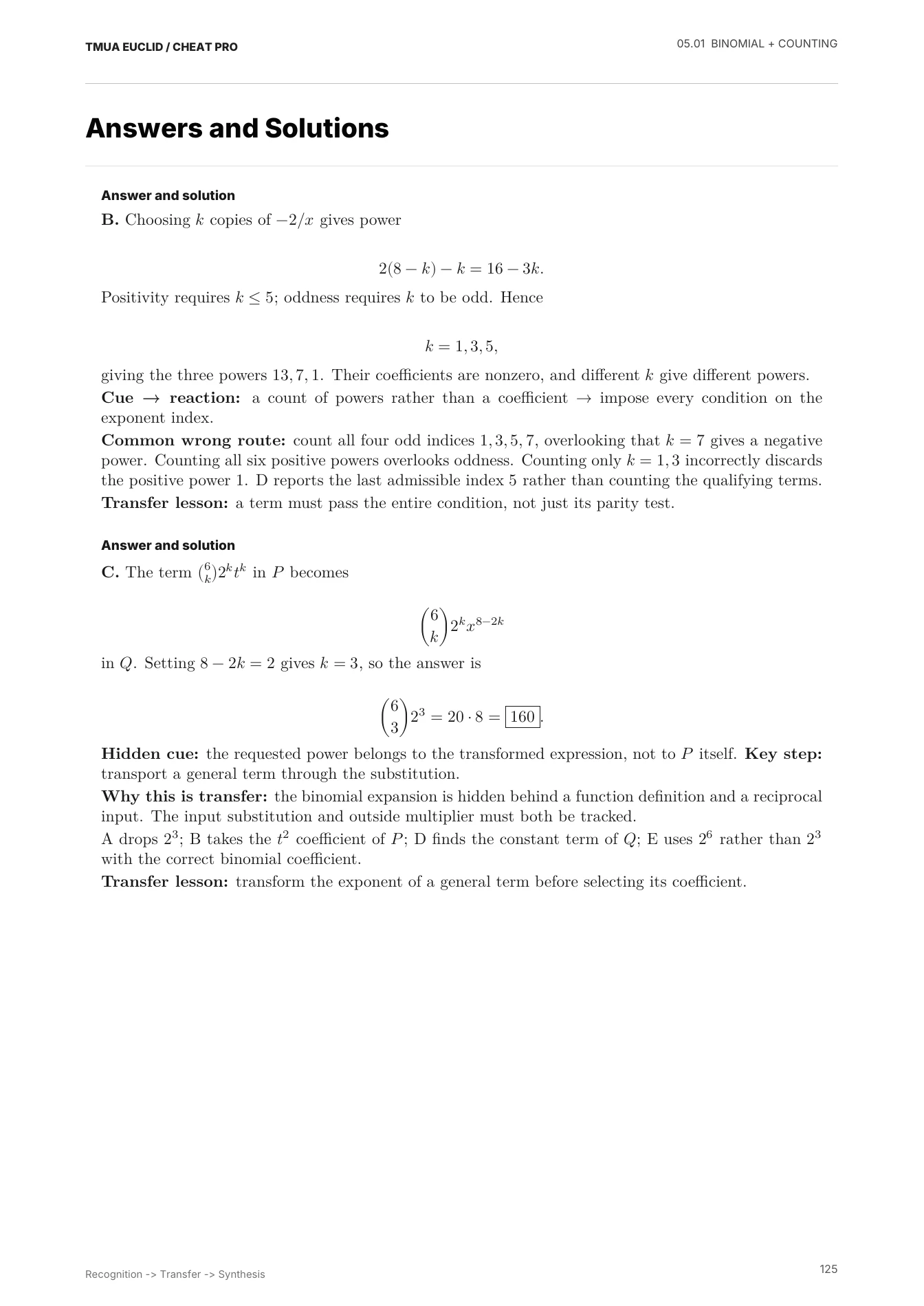
03 / ORIGINAL EUCLID QUESTIONS

Now make the decision yourself.

Three original questions develop the same idea in different ways. Try each one before opening the worked solution.

  1. I

    Recognition

    Spot the structure. Here, count which powers in an expansion are positive and odd.

  2. II

    Transfer

    Find the idea in a new form. Follow how a reciprocal substitution changes the power you need.

  3. III

    Synthesis

    Connect two methods. Extract a coefficient, then use optimisation to make it as large as possible.

Section 5.01 · Worked solutions

04 / QUESTION BANK & WORKED SOLUTIONS

Make every attempt teach you something.

The Euclid questions form a bank of 294 original problems inside the PDF, organised by method. Work on a weak topic or build a mixed practice session across chapters.

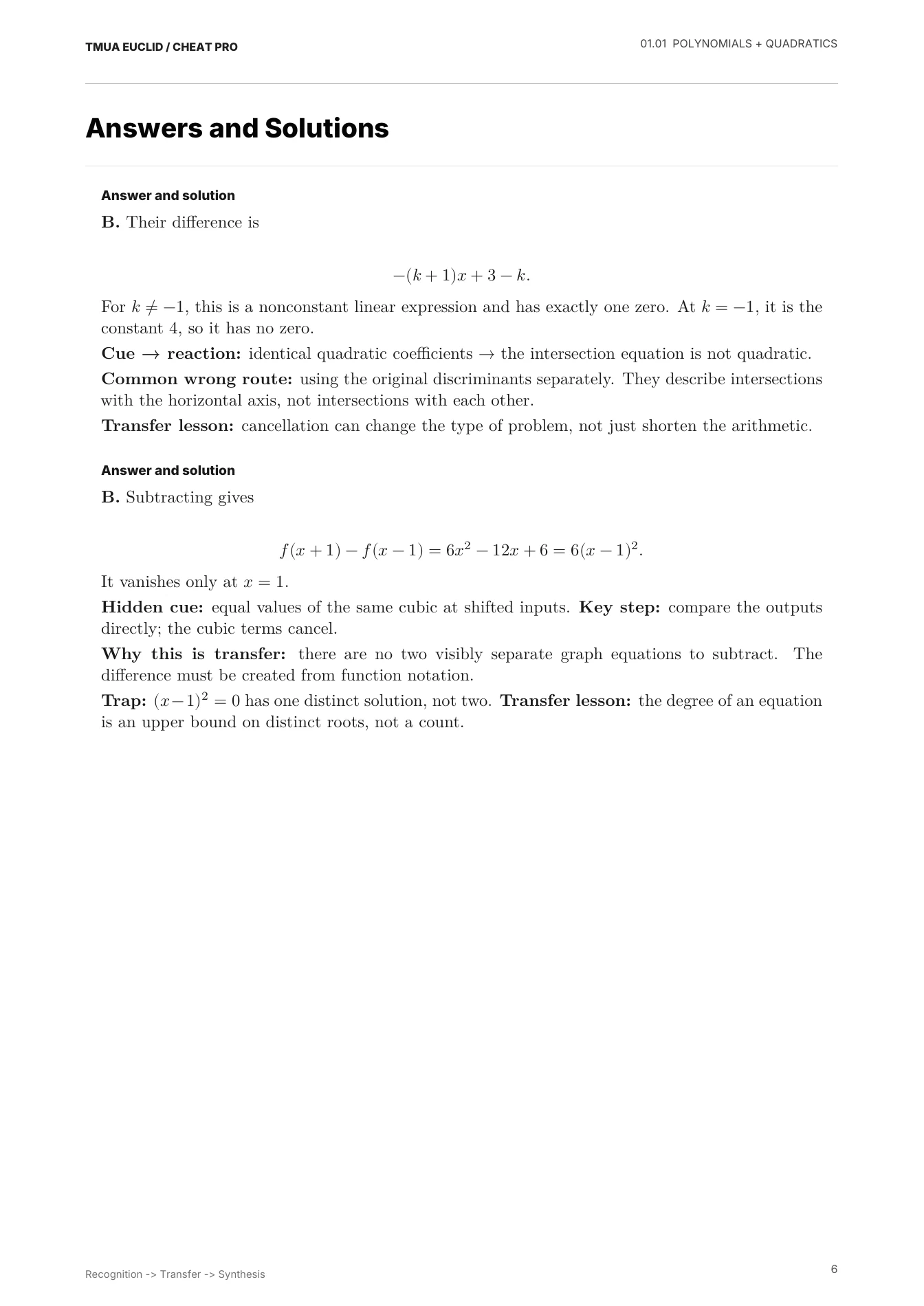
The solutions explain the key decision, unpack tempting wrong answers and finish with a takeaway you can carry into the next question.

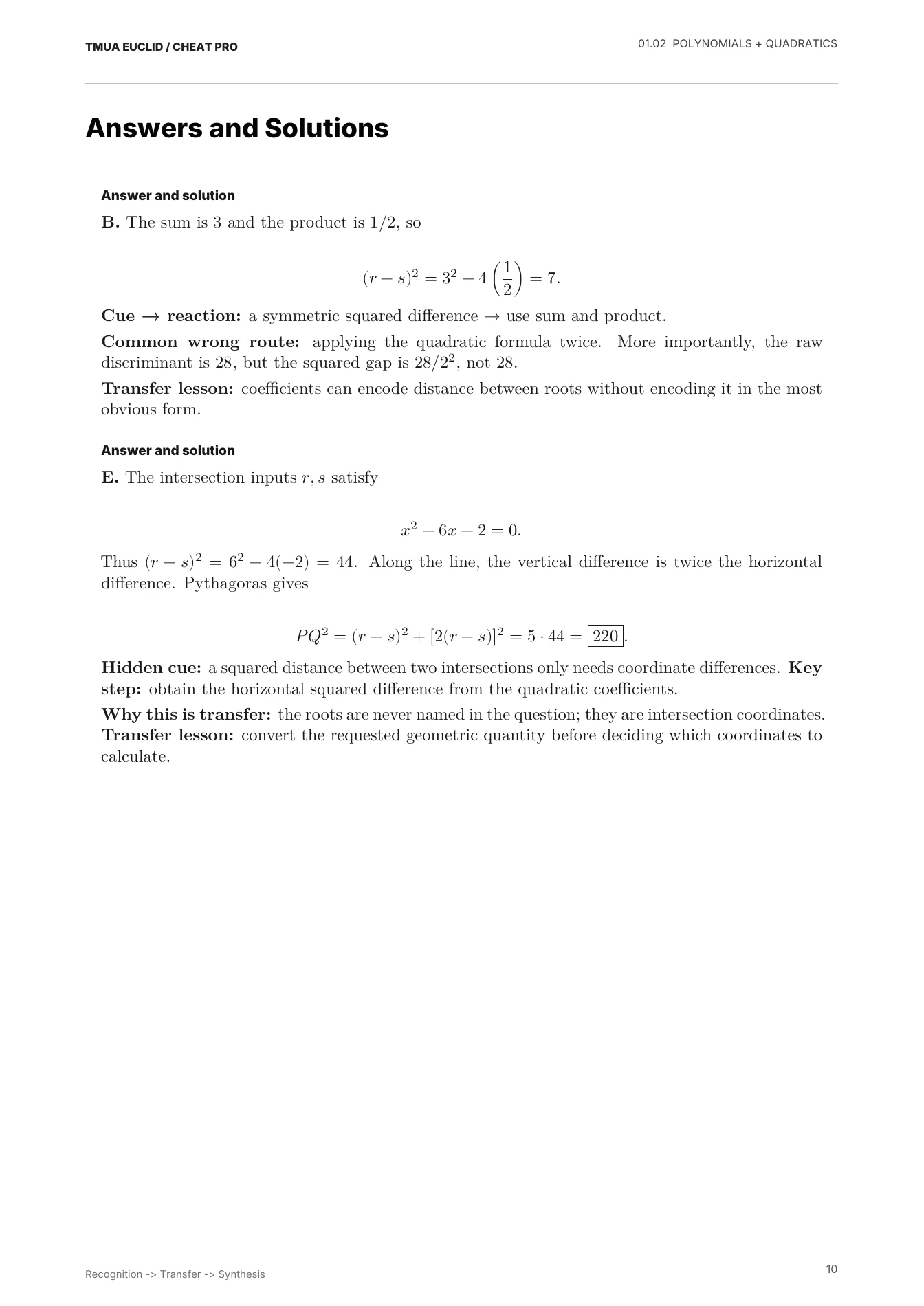
RECOGNITION & TRANSFER

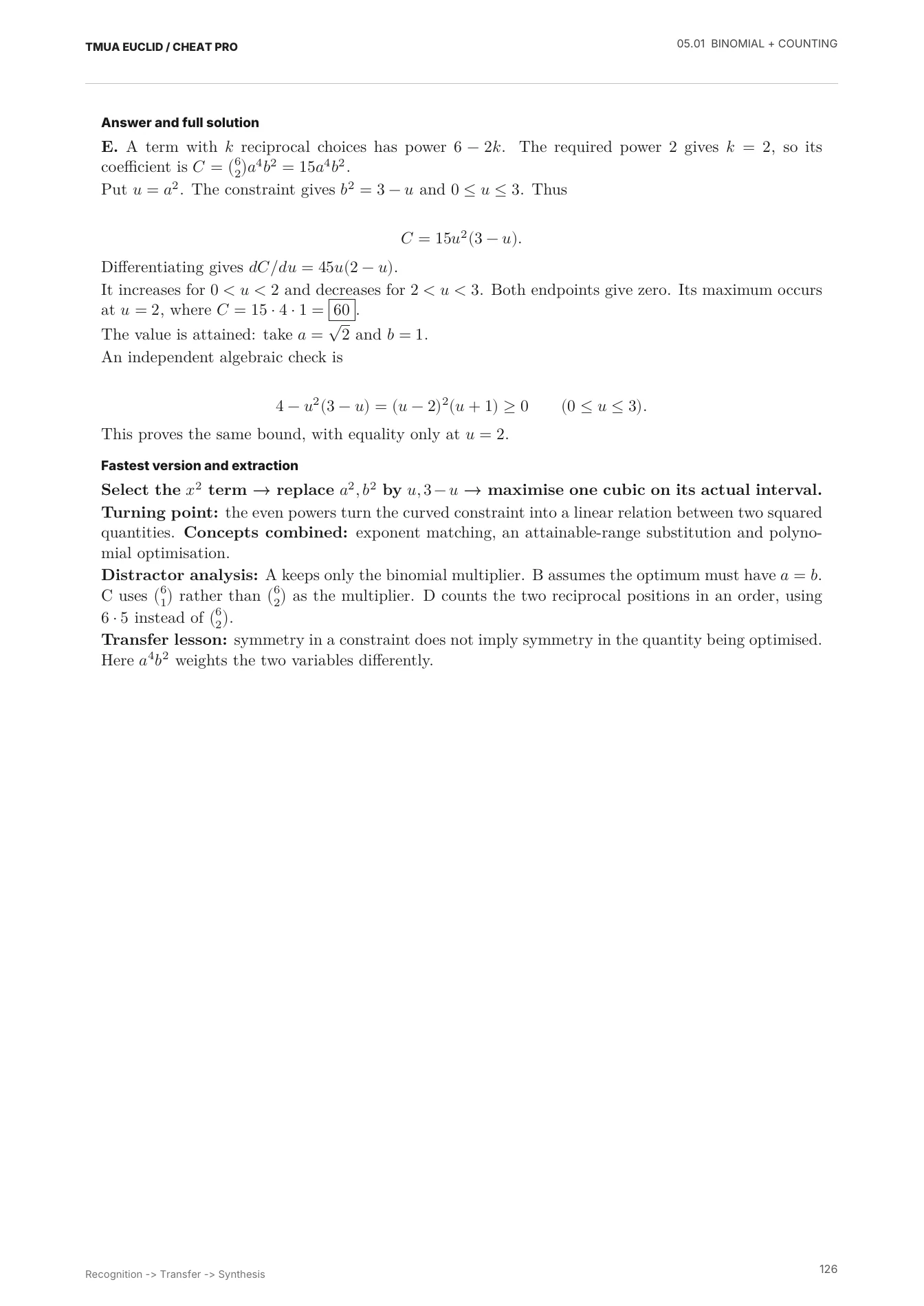
See why the recognition question has three eligible terms and how the reciprocal substitution in the transfer question gives 160.

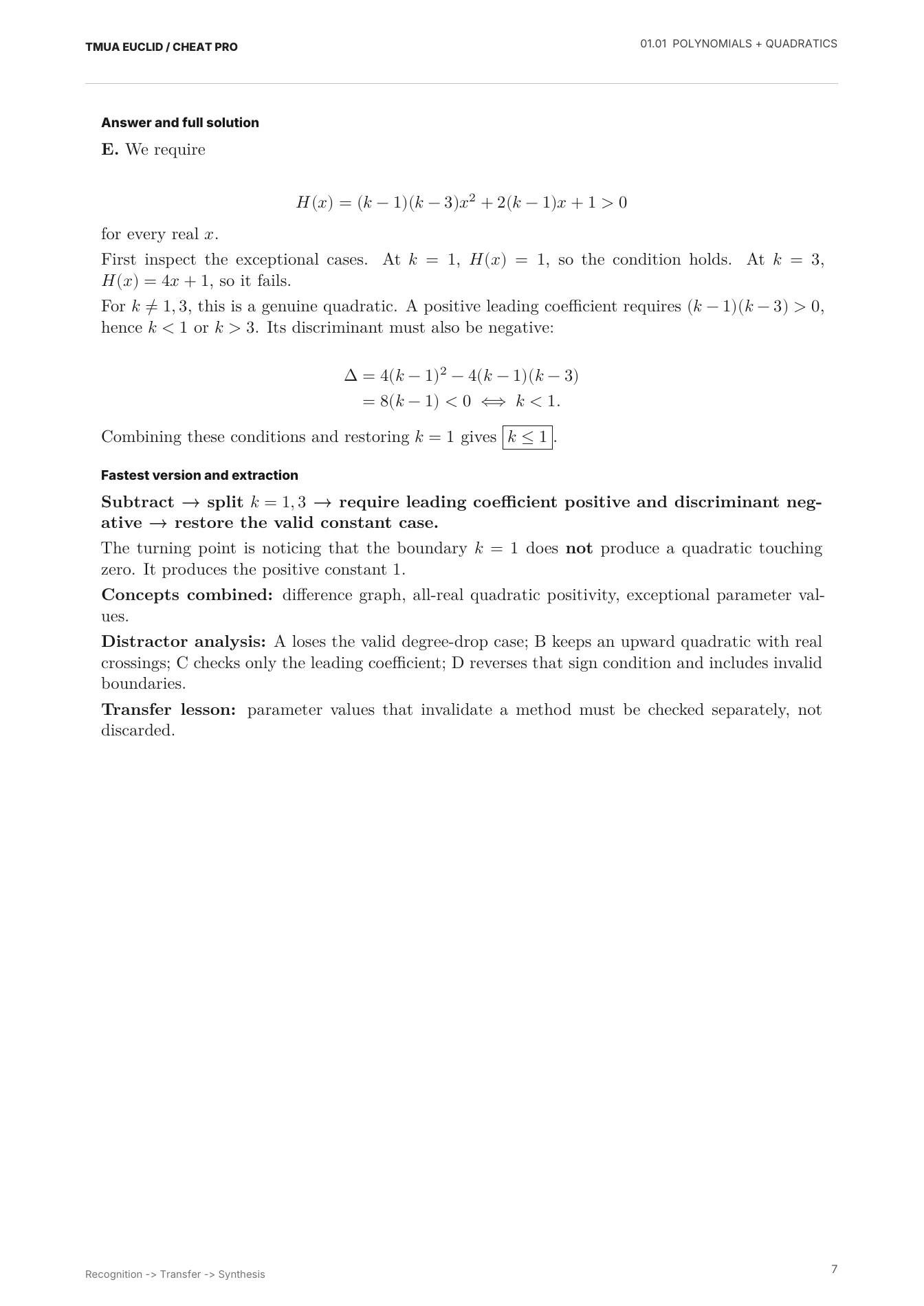
Section 5.01 · Synthesis solution and mental extraction

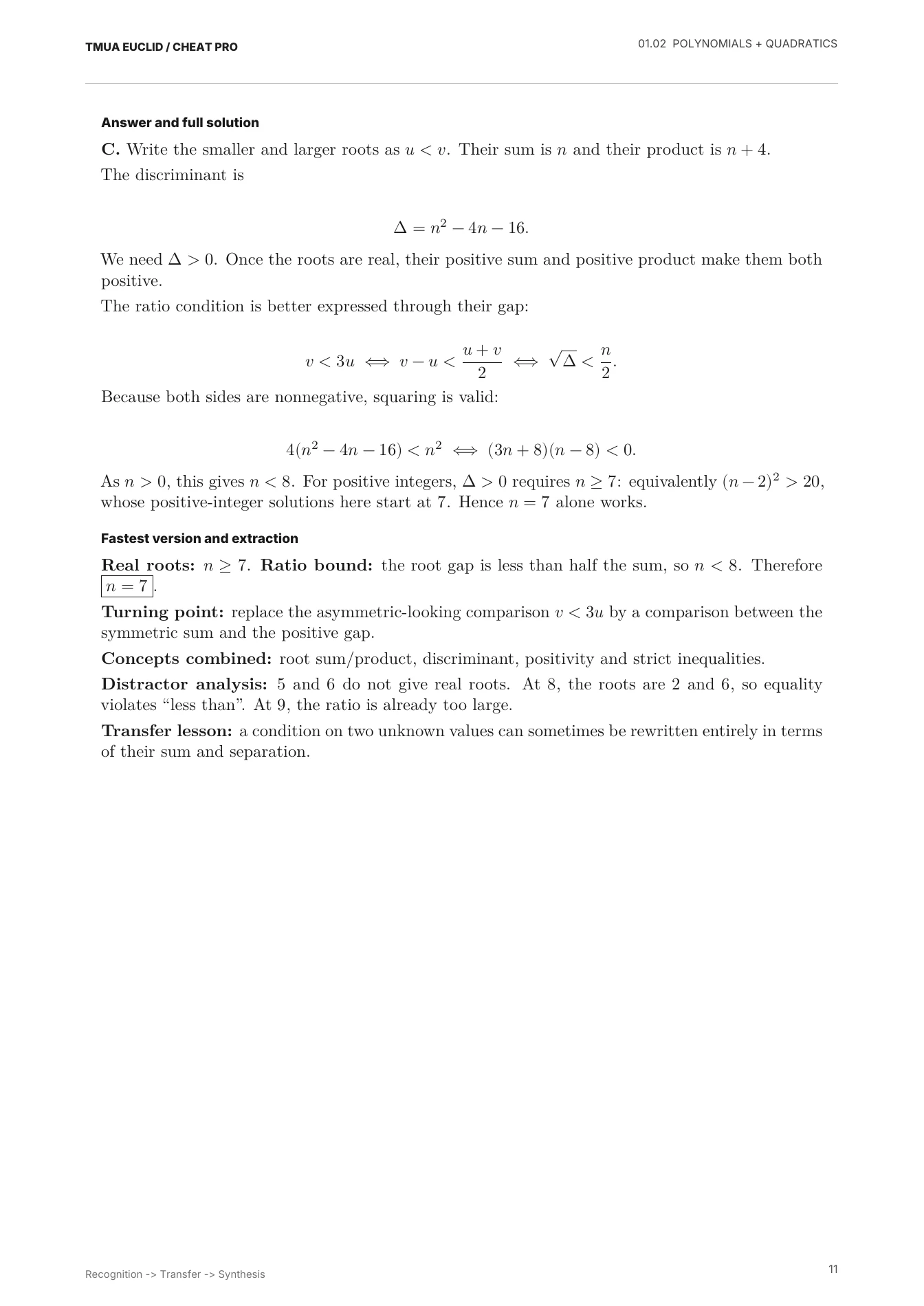
04 / WORKED SOLUTIONS · CONTINUED

The full synthesis solution.

This final page combines coefficient extraction with optimisation. Set u = a2 to rewrite the constraint as b2 = 3 − u, then maximise the coefficient over 0 ≤ u ≤ 3.

THE RESULT
C = 15u2(3 − u)

The maximum is 60 at u = 2, attained when a = √2 and b = 1.

The page includes the differentiation, an independent algebraic check and an explanation of each wrong answer. The takeaway: a symmetric constraint does not force the optimum to occur at a = b.

Inside Cheat Sheet Pro

THE COMPLETE RESOURCE

Everything you needfor TMUA Paper 1.In one PDF.

The methods, exam applications and practice, organised in one place.

THE DETAIL

420 pages.14 chapters.98 methods.

Go straight to a weak topic, or work through the resource chapter by chapter.

THE FOUNDATIONS

The concept.The key conditions.The common mistakes.

Understand why a method works, when it applies and where a solution can go wrong.

THE EXAM APPLICATION

Official TMUA questions.Euclid explanations.

See what to notice first, which method to choose and how to reach the answer.

THE PRACTICE

294 original questions.Full worked solutions.

Recognition, transfer and synthesis questions put each method to work in three different ways.
TMUA · EUCLID / PAPER 1

Cheat Sheet Pro.

One resource. Every method in reach.

Cheat Sheet Pro Paper 1 — front cover
£79ONE-TIME PURCHASE · DIGITAL PDF
Buy

Cart — 0

Your cart is empty.

Resource preview

Selected page from the resource